With shimmering pinks, hues of gray and a hint of brown, a newly released image of Saturn's rings resembles a fresco where nature is the painter.- The Cassini spacecraft captured this exquisite natural color view a few days before entering orbit around Saturn.
The images that make up this composition were obtained from Cassini's vantage point beneath the ring plane with the narrow angle camera on June 21, 2004.- The image was taken at a distance of 6.4 million kilometers (4 million miles) from Saturn.
The brightest part of the rings, curving from the upper right to the lower left in the image, is the B ring.- Many bands throughout the B ring have a pronounced sandy color.- Other color variations across the rings can be seen.- Color variations in Saturn's rings have previously been seen in Voyager and Hubble Space Telescope images. Cassini images show that color variations in the rings are more distinct in this viewing geometry than they are when seen from Earth.
Saturn's rings are made primarily of water ice. Since pure water ice is white, it is believed that different colors in the rings reflect different amounts of contamination by other materials, such as rock or carbon compounds. In conjunction with information from other Cassini instruments, Cassini images will help scientists determine the composition of Saturn's ring system.
In the 1980s, two Voyager spacecraft flew by Saturn as did Pioneer 11 in 1979.- Those fly-by missions raised tantalizing questions that can now be addressed by Cassini's planned four year tour.- Scientists have waited 25 years for an opportunity to answer these questions.-
The Cassini-Huygens mission is a cooperative project of NASA, the European Space Agency and the Italian Space Agency. The Jet Propulsion Laboratory, a division of the California Institute of Technology in Pasadena, manages the Cassini-Huygens mission for NASA's Office of Space Science, Washington, D.C. The Cassini orbiter and its two onboard cameras were designed, developed and assembled at JPL.- The imaging team is based at the Space Science Institute, Boulder, Colo.
For this and other images and information about the Cassini-Huygens mission, visit http://saturn.jpl.nasa.gov- and http://www.nasa.gov/cassini .- Images are also available at the Cassini imaging team home page, http://ciclops.org .
Articoli Correlati



Ultimi Articoli

Youth and Future a Palazzo Reale: le parole dei giovani diventano opere d’arte

Fibra ottica in provincia di Como: 145 comuni nel Piano Bul, oltre 144.000 immobili attivabili

Leone, il neonato ritrovato a Cinisello Balsamo respira senza supporto

Gaza, dalla Lombardia altri 150mila euro per acqua e assistenza agli sfollati
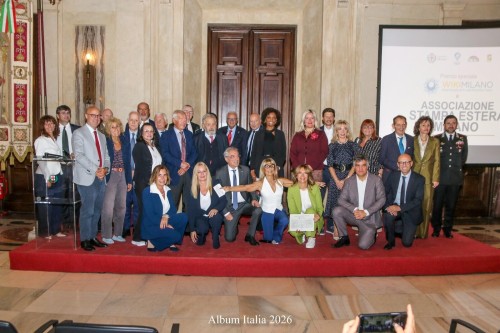
Milano premia i suoi protagonisti: a Palazzo Marino otto “Volti della Metropoli” che raccontano il futuro della città

Premio Volti della Metropoli: a Palazzo Marino i riconoscimenti alla VI edizione

Milano celebra i suoi protagonisti: torna il Premio “Volti della Metropoli”

Roma, talenti, Via Antamoro, vent’anni di attesa: ma chi paga il prezzo delle promesse rimaste sulla carta?

Winners Cup 2026, oltre 200 giovani pazienti oncologici in campo a Milano